When we talk about the EU Packaging and Packaging Waste Regulation (PPWR), we usually think about recyclability, recycled content and packaging waste.
But there is another issue inside the packaging production process that is often overlooked:
**Ozone.**
And for film manufacturers, the connection is closer than it may seem.
As the European packaging industry moves toward more recyclable and sustainable packaging solutions, the materials, structures and manufacturing processes behind those products are also receiving greater attention.
For many flexible packaging films, one important step remains **Corona Treatment**.
Corona treatment modifies the surface of plastic films to improve surface energy and enhance the adhesion of inks, coatings and adhesives during printing and lamination.
But there is a by-product that comes with the process:
**Ozone.**
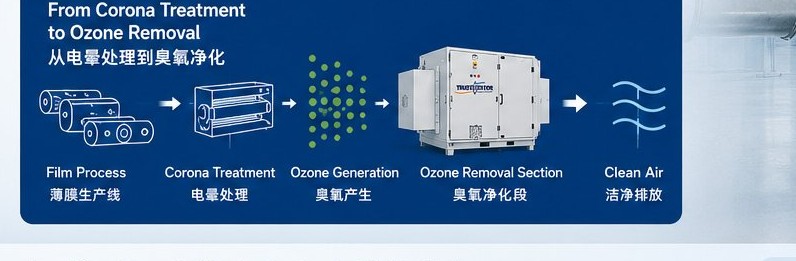
# Corona Treatment → Ozone Generation
Corona discharge generates ozone as part of the electrical discharge process.
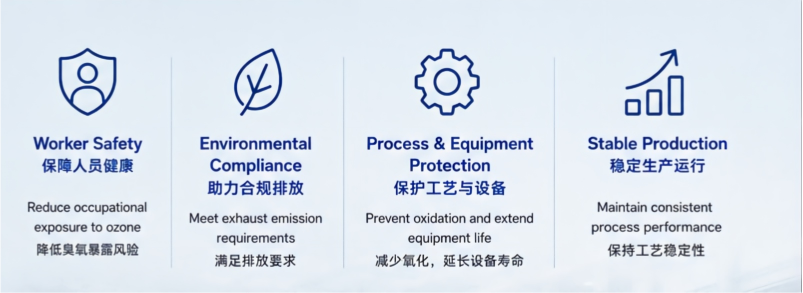
If ozone is not effectively captured and treated, it can enter the exhaust system and potentially affect the working environment, equipment and overall environmental performance of the production line.
This is why ozone removal should not be viewed simply as an “extra filter” on a film line.
It is an **engineering section of the exhaust system**.
A properly designed ozone purification system needs to consider:
• Where is ozone generated?
• How effectively is it captured?
• What is the actual airflow?
• What ozone concentration reaches the treatment section?
• Is the catalyst/filter configuration suitable for the operating conditions?
• How much pressure drop will the system create?
• How will performance be maintained over time?
The real question is therefore not simply:
**“Do we have an ozone filter?”**
It is:
**“Is our ozone purification section actually designed for our film production process?”**
This is becoming an increasingly relevant question for film extrusion, coating, printing and converting facilities supplying the European packaging market.
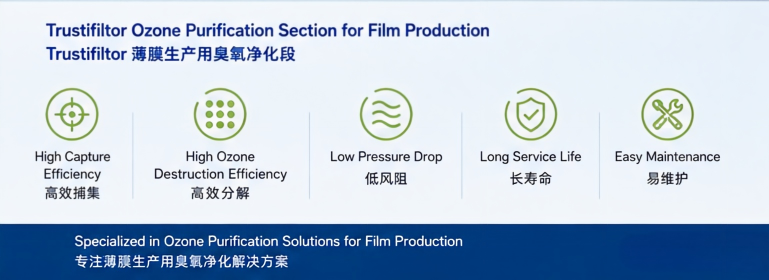
At **Trustifiltor**, we manufacture ozone purification sections specifically for film production applications.
We focus on the engineering behind ozone capture, purification efficiency, airflow and pressure-drop control — from the source factory.
**If you are reviewing the ozone removal system on your film line, we would be interested in understanding how your current system is designed.**
Leave us a message.
There may be a few things worth checking.
 Why do factories producing oral medical devices need ozone removal filter tubes?
 Types and characteristics of air purifier filters
 Introduction to microporous aluminum honeycomb core
 What operations should be avoided to control ozone in copiers